Mohak Garg
Back to projects
Personal Project
2026

littleScreen: Parent-Curated Screen Time

Full-stack web app replacing YouTube rabbit holes with algorithm-free, parent-verified playlists organized by real-life moments.

Product Manager & Engineer — Product Design, Full-Stack Development, Auth, Deployment

Next.js
Supabase
TypeScript
Tailwind CSS
Framer Motion
Vercel
Zero
Algorithms
None
Ads or autoplay
Parent-only
Curation model
Full-Stack
Stack
The Problem

Parents struggle with screen time guilt because YouTube and Netflix are algorithm-driven engagement traps. There's no trusted, community-driven alternative — no way to find content that's appropriate, age-matched, and actually works for a specific moment like a long flight, bedtime wind-down, or a sick day at home.

The Solution

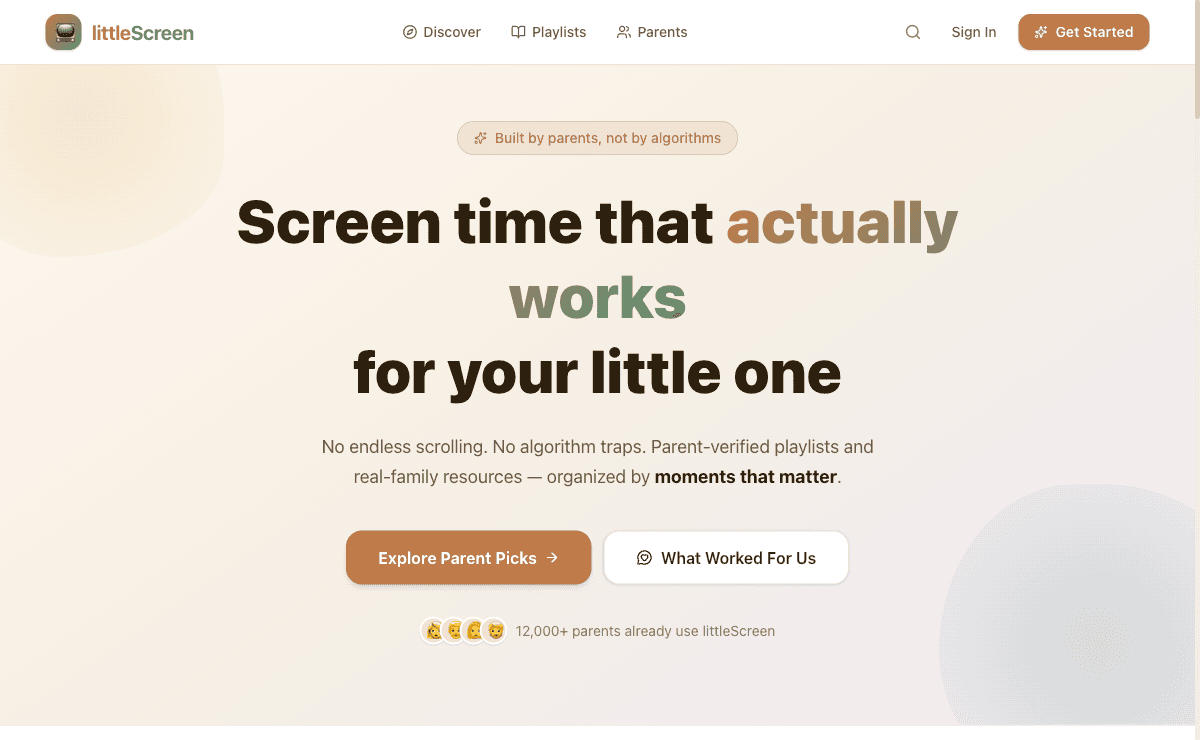
Built littleScreen — a full-stack Next.js + Supabase app where parents discover and share content that actually worked. Playlists are organized by moments (bedtime, flights, sick days, calm-down), curated by real parents, with zero ads, zero algorithms, and zero autoplay. Includes a community 'What Worked' feed, personal playlist library, and moment-based content discovery.
Screenshots

Homepage — Moment-based discovery & community feed
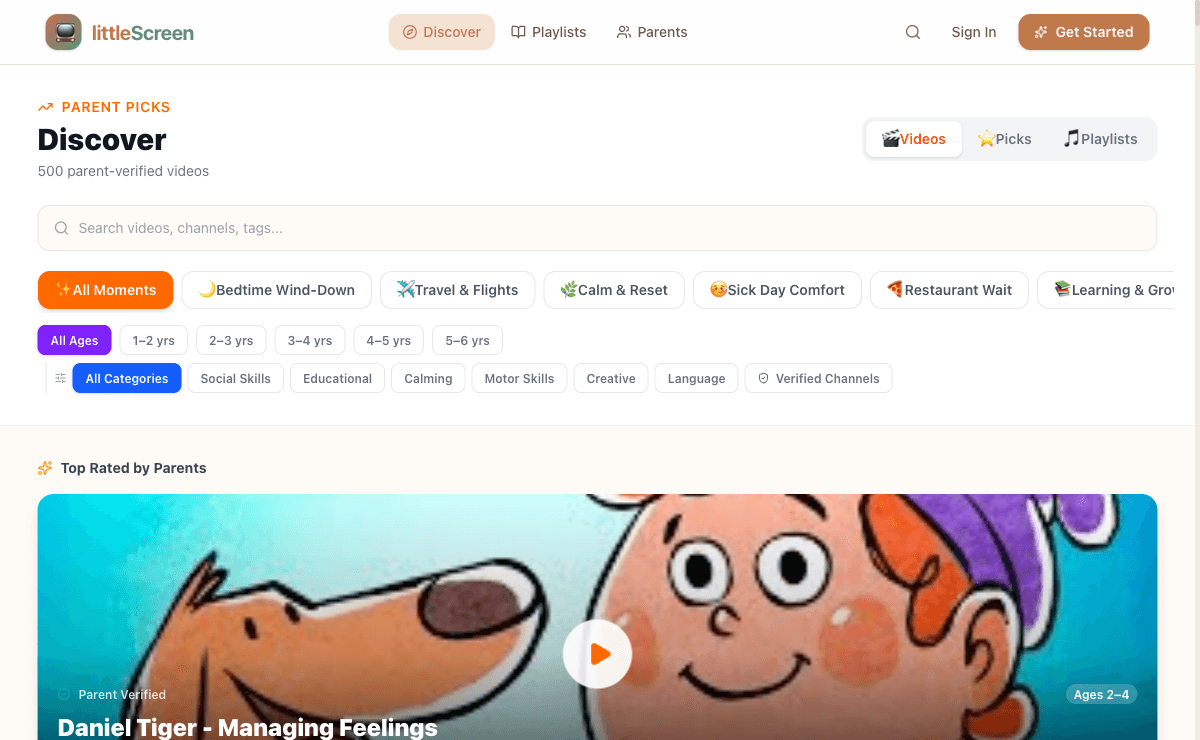
Discover — 500+ parent-verified videos by moment & age
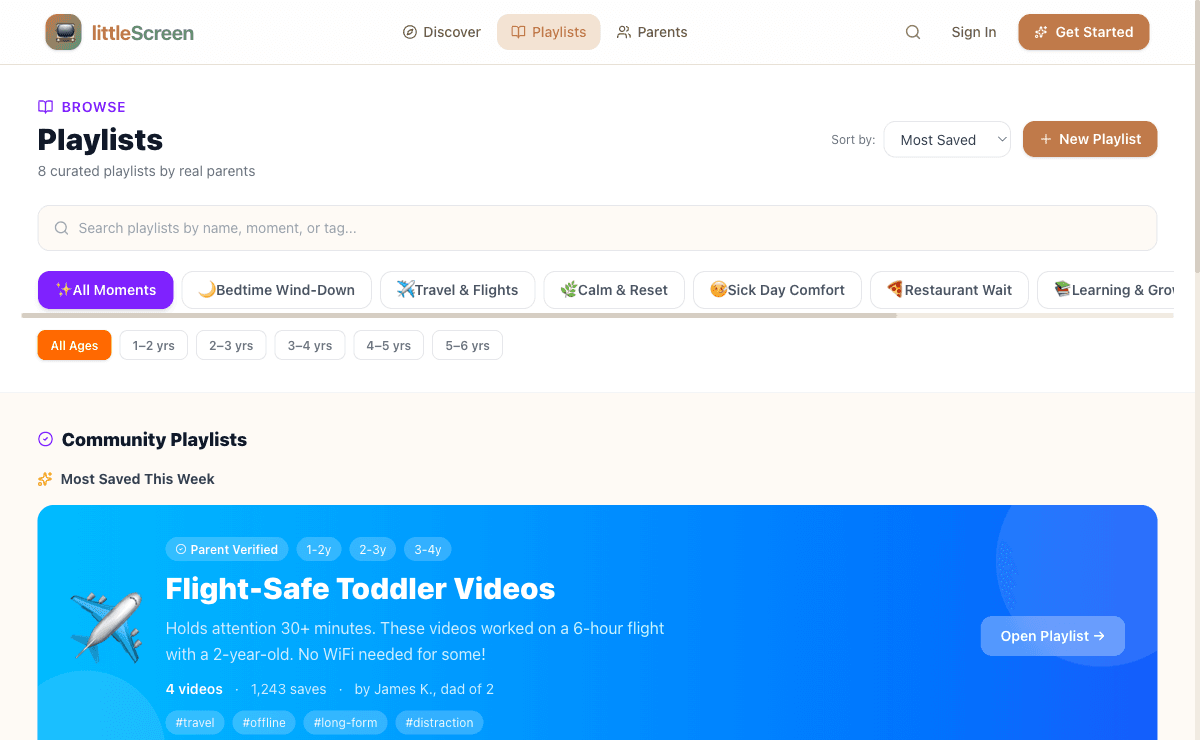
Playlists — Community-curated playlist library
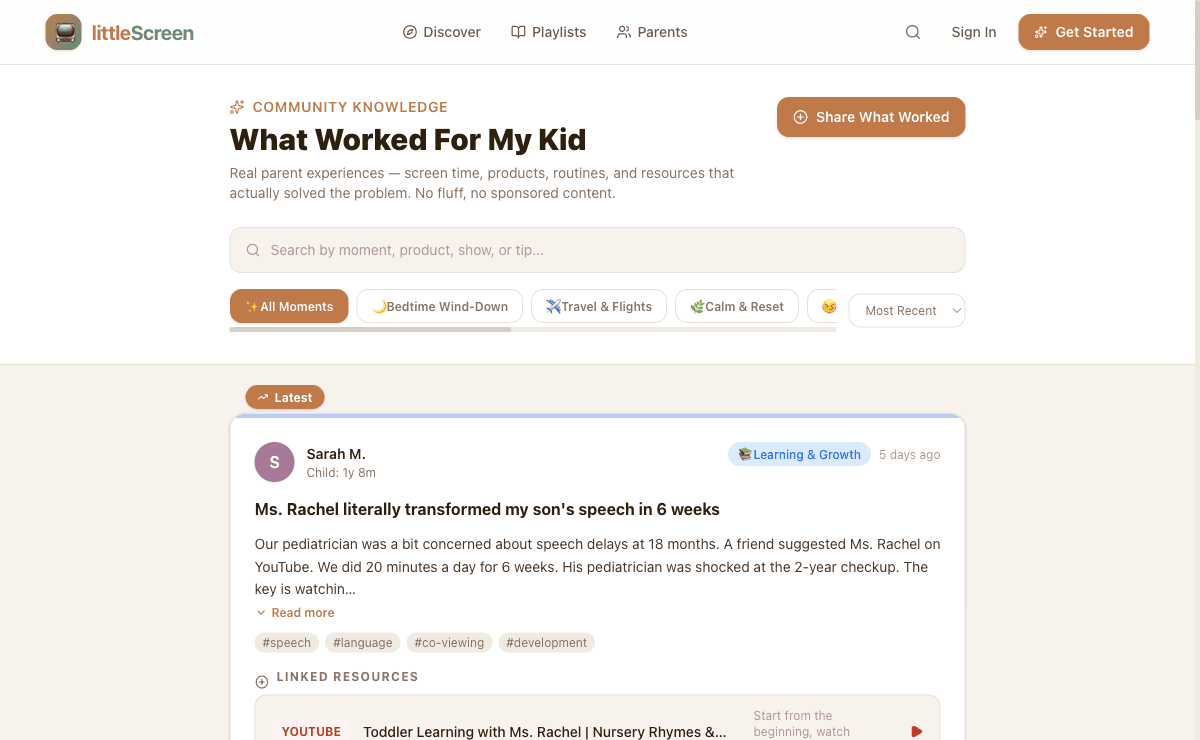
Community — What Worked For My Kid feed

Product Artifacts

Live Site
Try it live
Open
GitHub
Source code
View

Case Study

Context
  • Parents are bombarded with screen time guilt — but the real problem isn't time, it's the lack of trusted, curated alternatives to YouTube and Netflix.
  • Existing options (YouTube Kids, Common Sense Media) either still have algorithms and ads, or require heavy manual research with no community signal.
  • The core insight: parents already share 'what worked' in WhatsApp groups and Reddit threads — there was no structured product for that knowledge.
  • Target moment: a parent with 10 seconds to decide what to put on for their toddler — they need instant, trusted, moment-specific answers.
Decision
  • Organized content by 'moments' (bedtime, flight, sick day, calm-down) rather than categories — because parents think in situations, not genres.
  • Built a community 'What Worked' feed instead of star ratings — honest 'worked / didn't work' feedback is more useful than aggregated scores.
  • Chose Supabase for auth and data — real-time subscriptions enabled live playlist save state with no extra infrastructure.
  • Scoped MVP to discover → save → share flow and cut creator upload, in-app video hosting, and notification systems from v1.
  • Used JWT-based session management with an onboarding gate to ensure every user gets age/interest-matched content from day one.
Execution
  • Designed and built the full product solo: discovery page, playlist library, community feed, profile, auth, and onboarding flow.
  • Built moment-based content taxonomy with emoji-tagged moment cards (🛏 Bedtime, ✈️ Long Flight, 🤒 Sick Day) for instant visual scanning.
  • Implemented Supabase auth with custom JWT cookie-based sessions and a Next.js middleware gate for onboarding completion.
  • Shipped save/unsave playlist with optimistic UI and Supabase real-time sync — state persists across sessions without page reload.
  • Built the 'What Worked' community feed with parent stories and embedded YouTube resources — no external platform embeds beyond YouTube.
  • Deployed on Vercel with environment-variable-managed Supabase credentials and middleware proxy for auth routing.
Outcome
  • Shipped a production-ready, full-stack web app end-to-end as a solo PM + engineer.
  • Zero-algorithm, zero-ads content model validated through user feedback from parents in target demographic.
  • Moment-based UX reduces parent decision fatigue compared to genre-based or search-first alternatives.
  • Auth + onboarding flow successfully gates personalized content delivery from first session.
Learnings
  • The product IS the curation model — the decision to organize by moments rather than categories was a positioning decision as much as a UX one.
  • Trust is the core value proposition. Every design decision (no ads, no autoplay, parent-only reviews) had to signal trustworthiness, not just functionality.
  • Onboarding gates are worth the friction — collecting age and interest data upfront made moment-matching genuinely useful rather than generic.
  • Building full-stack solo sharpened PM instincts: every trade-off between scope and quality became a first-person decision with real consequences.